
Every Image media file comes with certain metadata attached to it which provides more information about it, like technical information, information about its origin, its integrity, copyrights etc. In this article we look at various metadata, what information they contain and their importance in GEO and AI Visibility.
EXIF (Exchangeable Image file Format)
EXIF was invented in 1990s is basically a file description. It tracks technical details about how an image was shot or designed. All electronic devices like camera and smartphones attach EXIF data. It will contain information like camera model number, lens model number, shutter speed, aperture, ISO, focal length, date, time and if location settings are on then location along with GPS coordinates
The primary issue with EXIF is that it is not cryptographically signed, can easily be viewed, edited or deleted completely. When EXIF data is stripped off, it leaves no trace what so ever.
C2PA (Coalition for Content Provenance and Authenticity)
C2PA is a modern framework founded in 2021. Its founding members include Adobe, Microsoft, BBC, Intel, Arm and Truepic. C2PA content credentials is a cryptographically verifiable provenance history of an image, in the form of a manifest. It provides with the provenance, integrity and attribution to the owner and various components of that media file.
C2PA provides secure proof of who made the image or whether it was modified. Provides content authenticity and history. It uses cryptographic private public key encryption and is tamper evident. When someone tries to modify C2PA, it breaks the digital seal, which still stays attached to the image with evidence of tampering
Both EXIF and C2PA can provide information like What is the origin of this image, when was it created, what software or device was used, how has it been edited. However, both these provide different context. We’ll later see with an example.
ITPC (International Press Telecommunications Council)
ITPC was founded in Year 1965 to safeguard the interests of the press, particularly the exchange of media between organisations. The concept designed for the web now by default extends to LLMs and AI systems.
AI systems are becoming multi-modal and by default look for content that is authentic, trustworthy has transparent definition of the ownership and copyrights, even for the images they use inline in their answers. Thos framework explicitly provides all of this information for AI systems to attribute trust score to the brand or person’s digital footprint and establish their authority.
IPTC defines standardised metadata files used by photographers, news organisations, media publishers and libraries. ITPC field may include information like Title/headline, Description/Caption, Creator/Photographer, Copyright, Creator’s contact information, Location, Keywords, Credit, Right usage terms, Date created.
XMP (Extensible Metadata Platform)
XMP is a framework which was developed by Adobe in 2001. It provides framework for embedding structured information into media files. It may include information like IPTC metadata, Adobe metadata, Copyright information, editing information, ratings, keywords, custom application metadata etc.
There is an overlap in the information of XMP and IPTC because in 2004, it was announced that ITPC’s metadata will be mapped to the XMP Framework.
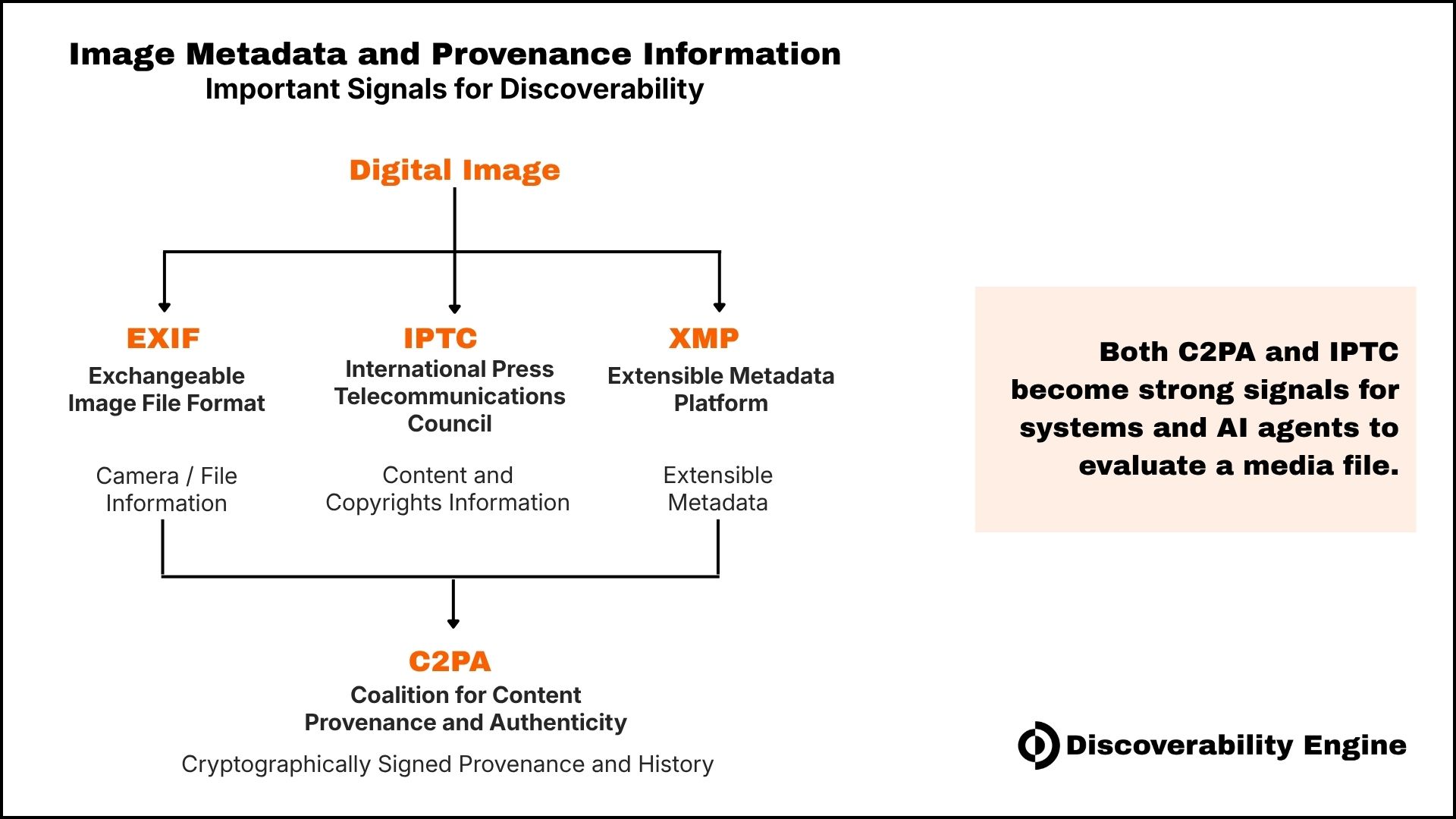
Lets look at an example to understand all the four frameworks: EXIF, ITPC, XMP and C2PA
Example: An image has been clicked by a photographer named Itika Singhal in Gurgaon using her DSLR for a launch of a digital product, say, iPhone 18.
Image EXIF will say something like a label on package:
Camera: Nikon D5300
Date: 15th September 2026
Location: Gurugram
Software: Adobe Photoshop
IPTC might say:
Creator: Itika Singhal
Headline: New product launch
Caption: Launch photograph of Apple’s iPhone 18
Copyright: © Itika Singhal
Keywords: Apple iPhone, iPhone 18, iPhone18 launch, iPhone 18 Pro Max
Location: Gurugram
XMP might contain:
Product Colour: Burgundy
Product Model: iPhone 18 Pro Max
Keywords: Apple iPhone, iPhone 18, iPhone18 launch, iPhone 18 Pro Max Editing application: Lightroom
C2PA manifest might say:
Image Shot by Itika Singhal -> Shot on Nikon D5300 -> Edited in Lightroom -> Exported -> Provenance signed by Itika Singhal
C2PA is a manifest, tamper evident chain of custody information attached to the image. It stores the entire journey of the image instead of just the facts. Lineage is the real power of C2PA.
How these frameworks affect AI Visibility
EXIF data which is the technical metadata about a file gives very less contribution towards evaluating the authenticity and attributing a trust score. Hence, there is very minimal affect of it on the AI Visibility.
IPTC and C2PA form a stronger trust signal together.
IPTC is used by content creators, photographers, media houses and press releases to provide information and copyrights about the image, safe guarding the interests of the image owner. XML which now party contains IPTC information, becomes equally important. They have medium to high importance when to evaluate trust and authenticity of an image.
With high trust scores, the changes of these images being cited inline within AI answers increases significantly.
C2PA which provides provenance information, integrity as well as attribution to the creator in a tamper evident manner, provide high value in trust score evaluation. The sole purpose of this framework has been to differentiate human generated content from AI generated or modified content. LLMs and AI systems evaluating C2PA manifests, if they find high trust and authenticity, then it is highly likely that the images will be used within AI answers and recommendations.